 ケネス・T・ヤング書簡
Letter Officeを北東アジア部(ケネスT.ヤング、ジュニア、監督局北東アジア部)からÉ.アランLightner米国大使館は、韓国の釜山- より抜粋 機密情報のセキュリティ情報竹島について 〜の上に 出典:フリー百科事典。
Confidential Security Information about Liancourt Rocks
KennethYoungLetter
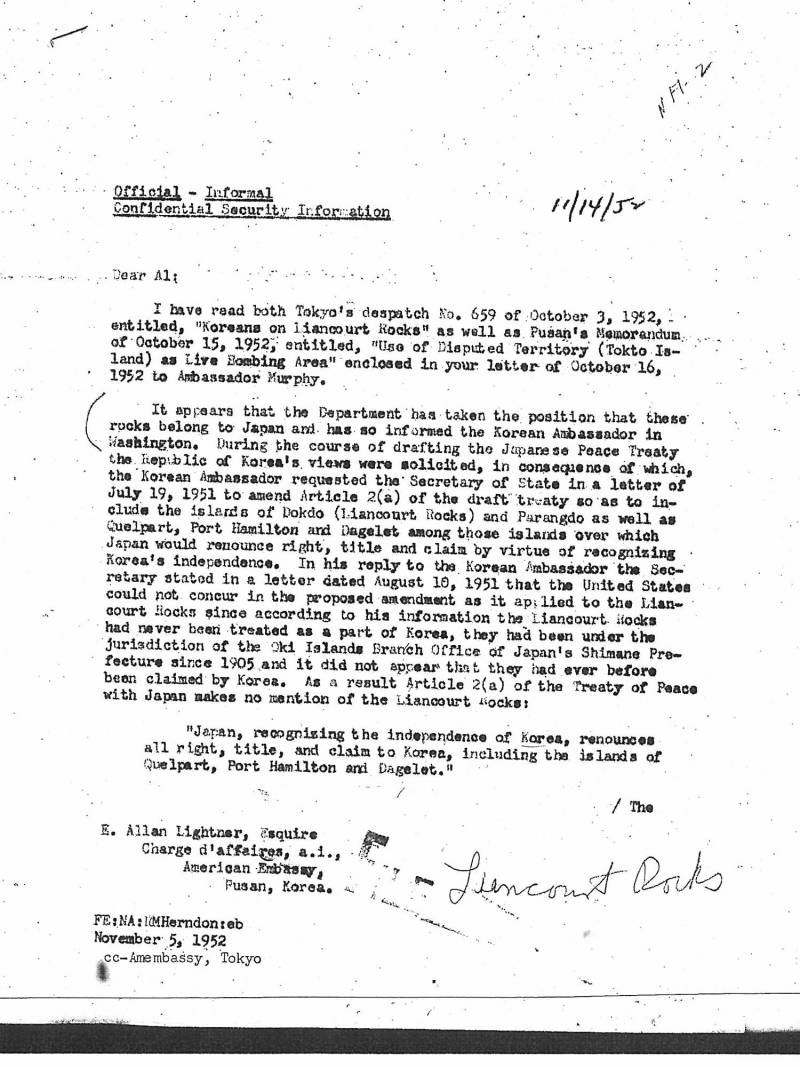
Official - Informal
Confidential Security Information
11/14/52
Dear Al:
I have read both Tokyo"s despatch No. 659 of October 3, 1952, entitled, "Koreans on Liancourt Rocks" as well as Pusan"s Memorandum of October 15, 1952, entitled, "Use of Disputed Territory (Tokto Island) as Live Bombing Area" enclosed in your letter of October 16, 1952 to Ambassador Murphy.
It appears that the Department has taken the position that these rocks belong to Japan and has so informed the Korean Ambassador in Washington. During the course of drafting the Japanese Peace Treaty the Republic of Korea"s views were solicited, in consequence of which, the Korean Ambassador requested the Secretary of State in a letter of July 19, 1951 to amend Article 2(a) of the draft treaty so as to include the islands of Dokdo (Liancourt Rocks) and Parangdo as well as Quelpart, Port Hamilton and Dagelet among those islands over which Japan would renounce right, title and claim by virtue of recognizing Korea"s independence. In his reply to the Korean Ambassador the Secretary stated in a letter dated August 10, 1951 that the United States could not concur in the proposed amendment as it applied to the Liancourt Rocks since according to his information the Liancourt Rocks had never been treated as a part of Korea, they had been under the jurisdiction of the Oki Islands Branch Office of Japan"s Shimane Prefecture since 1905 and it did not appear that they had ever before been claimed by Korea. As a result Article 2(a) of the Treaty of Peace with Japan makes no mention of the Liancourt Rocks:
"Japan, recognizing the independence of Korea, renounces all right, title, and claim to Korea, including the islands of Quelpart, Port Hamilton and Dagelet."
/ The
E. Allan Lightner, Esquire
Liancourt Rocks
Charge d"affaires, a.i.,
American Embassy,
Pusan, Korea.
FE:NA:RMHerndon:eb
November 5, 1952
cc-Amembassy, Tokyo
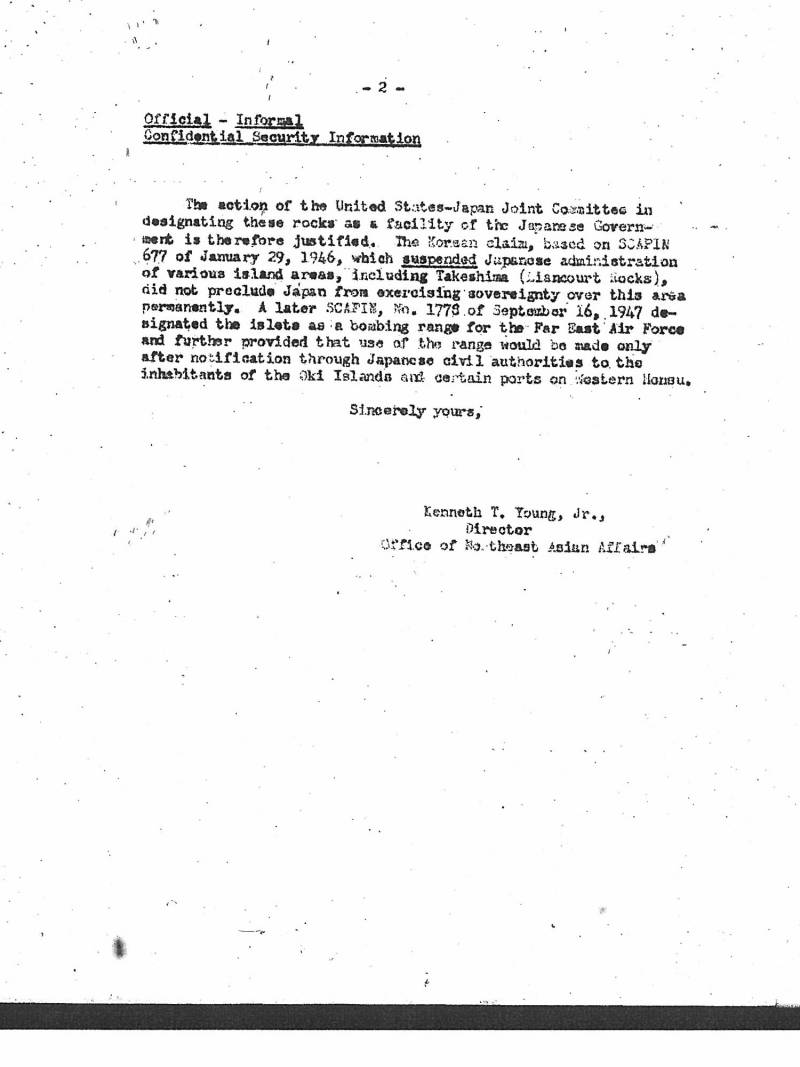
Official - Informal
Confidential Security Information
The action of the United States-Japan Joint Committee in designating these rocks as a facility of the Japanese Government is therefore justified. The Korean claim, based on SCAPIN 677 of January 29, 1946, which suspended Japanese administration of various island areas, including Takeshima (Liancourt Rocks), did not preclude Japan from exercising sovereignty over this area permanently. A later SCAPIN, No. 1778 of September 16, 1947 designated the islets as a bombing range for the Far East Air Force and further provided that use of the range would be made only after notification through Japanese civil authorities to the inhabitants of the Oki Islands and certain ports on Western Honsu.
Sincerely yours,
Kenneth T. Young, Jr.,
Director
Office of Northeast Asian Affairs
拝啓
東京の「リアンクール岩に韓国人」と題する1952年10月3日付け伝達書659号及びマーフィー(Murphy)大使あて1952年10月16日付け貴簡に添付された釜山の「領有権が争われている領土(独島)の実射訓練場としての使用」と題する1952年10月15日付け覚書を読みました。国務省は、この島が日本に属するとの立場をとり、その旨をワシントンの韓国大使に伝えたようです。
日本平和条約の起草過程において大韓民国の見解が求められ、その結果、韓国大使は、1951年7月19日付け書簡を以って国務長官に、条約草案第2条a項を修正して日本が朝鮮の独立の承認に伴い権利権原請求権を放棄すべき島に済州島、巨文島、鬱陵島と並んで独島(リアンクール岩)と波浪島を含めるよう要請しました。
韓国大使に対する返答として国務長官は、1951年8月10日付け書簡で、彼の情報によればリアンクール岩は朝鮮の一部として取り扱われたことが決してなく、1905年から日本の島根県隠岐支庁の管轄下にあり、かつて朝鮮によって領土主張がなされたとは思えないので、提案に係るリアンクール岩に関する修正に同意できないと述べました。その結果、平和条約第2条a項には、次のとおり、リアンクール岩が言及されないことになりました。「日本国は、朝鮮の独立を承認して、済州島、巨文島及び鬱陵島を含む朝鮮に対するすべての権利、権原及び請求権を放棄する。」
É.アランLightner、エスクァイア
担当公使、『AI』、
アメリカの大使館、
プサン、韓国。
鉄:ナ:RMHerndon:CDM理事会
1952年11月5日
それゆえ日米合同委員会によるこの島の日本政府の施設としての指定は正当化されます。
竹島(リアンクール岩)を含む種々の島嶼地域に対する日本の施政を「停止した」(suspended)1946年1月29日のSCAPIN677に基づく領土主張を韓国はしていますが、これによって日本がこの地域に永続的に主権を行使することが排除されることはありませんでした。後続のSCAPINである1947年9月16日付け第1778号は、同島を極東空軍の射爆場として指定し、さらに、当該射爆場の使用は、日本の文民当局を通じて隠岐及び本州西部の住民に通告した後にはじめて行われると規定しました。
敬具
ケネスT.ヤング、ジュニア、
北東アジア課オフィスの局長