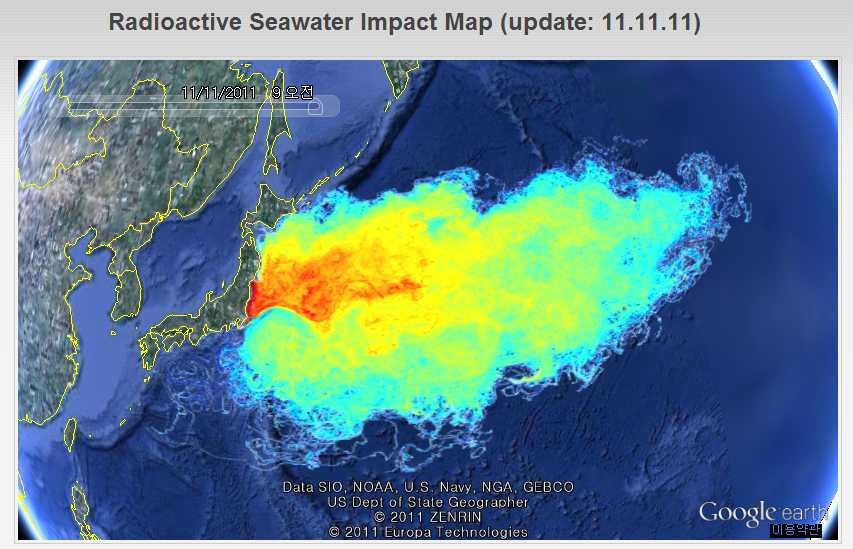
(福島放出) 放射性物質の海水影響指導 (アップデート : 2011年 11月 11日)
We use a Lagrangian particles dispersal method to track where free floating material (fish larvae, algae, phytoplankton, zooplankton...) present in the sea water near the damaged Fukushima Daiichi nuclear power station plant could have gone since the earthquake on March 11th. THIS IS NOT A REPRESENTATION OF THE RADIOACTIVE PLUME CONCENTRATION. Since we do not know how much contaminated water and at what concentration was released into the ocean, it is impossible to estimate the extent and dilution of the plume. However, field monitoring by TEPCO and modelling by the Sirrocco group in University of Toulouse, France both show high concentration in the surrounding water (highest rate at 80 Bq/L and 24 Bq/L for respectively I-131 and C-137) . Assuming that a part of the passive biomass could have been contaminated in the area, we are trying to track where the radionuclides are spreading as it will eventually climb up the food chain.
The dispersal model is ASR¥"s Pol3DD. The model is forced by hydrodynamic data from the HYCOM/NCODA system which provides on a weekly basis, daily oceanic current in the world ocean. The resolution in this part of the Pacific Ocean is around 8km x 8km cells. We are treating only the sea surface currents. Particles in the model are continuously released near the Fukushima Daiichi power plant since March 11th. The dispersal model keeps a trace of their visits in the model cells. The results here are expressed in number of visit per surface area of material which has been in contact at least once with the highly concentrated radioactive water.
私たちは損傷されたHukushimaDaichi原典近く海水に現われる富裕物質 (魚卵, 潮流, 植物性プランクトン, 動物性プルレングクトンなど)らが 311 大震災以来に行くことができる所を追跡する Lagrangian 粒子分散方法を使います. これは放射性物質濃度の表現ではないです. どれだけ多くの汚染した水がどんな濃度で海に流入されたのかをわからないから機動の範囲と希薄を推正することは不可能です. しかし東京全力とフランスツールーズ大学のシロッコグループによる現場モニタリングは二つとも皆周辺海水(代表的にヨード・ヨジウモ131とセシウム137から 80Bq/Lと 24Bq/Lに最高の割合)で高い濃度を見せます. この地域で受動的に生物たち一部がこの地域で汚染したことがあるという前題下に, 私たちは放射性核腫が徐徐にえさ鎖に付いて拡散することを追跡しようと試みます. 分散モデルは ASRの Pol3DDです. このモデルは私は世界海で日刊,週刊単位に提供された HYCOM/NCODA システムの流体データによって影響されます. 太平洋海のこの部分での分割は 8kmX8km セルです. 私たちはただ海表なら流れをツィグブニだ.モデルで粒子たちは持続的に 311 以来HukushimaDaichi近くで放出されます. 分散モデルはモデルセルで 訪問の跡を維持します. ここで結果は最小一度高濃度放射性海水と接触した物質の表面面当たり訪問数を現わします.