

Envelope sent by National Archives to confirm the validity of the followingdocuments.
Recipient Mr. Tony Marano (PropagandaBuser : Texas Daddy : テキサス親父)
Click each photo for larger image
Click HERE to download full archives in zip file.米国国立公文書館よりテキサス親父へ送られて来た封筒と手紙
左の写真をクリックで拡大
全てのファイル一括ダウンロードするには ここをクリック
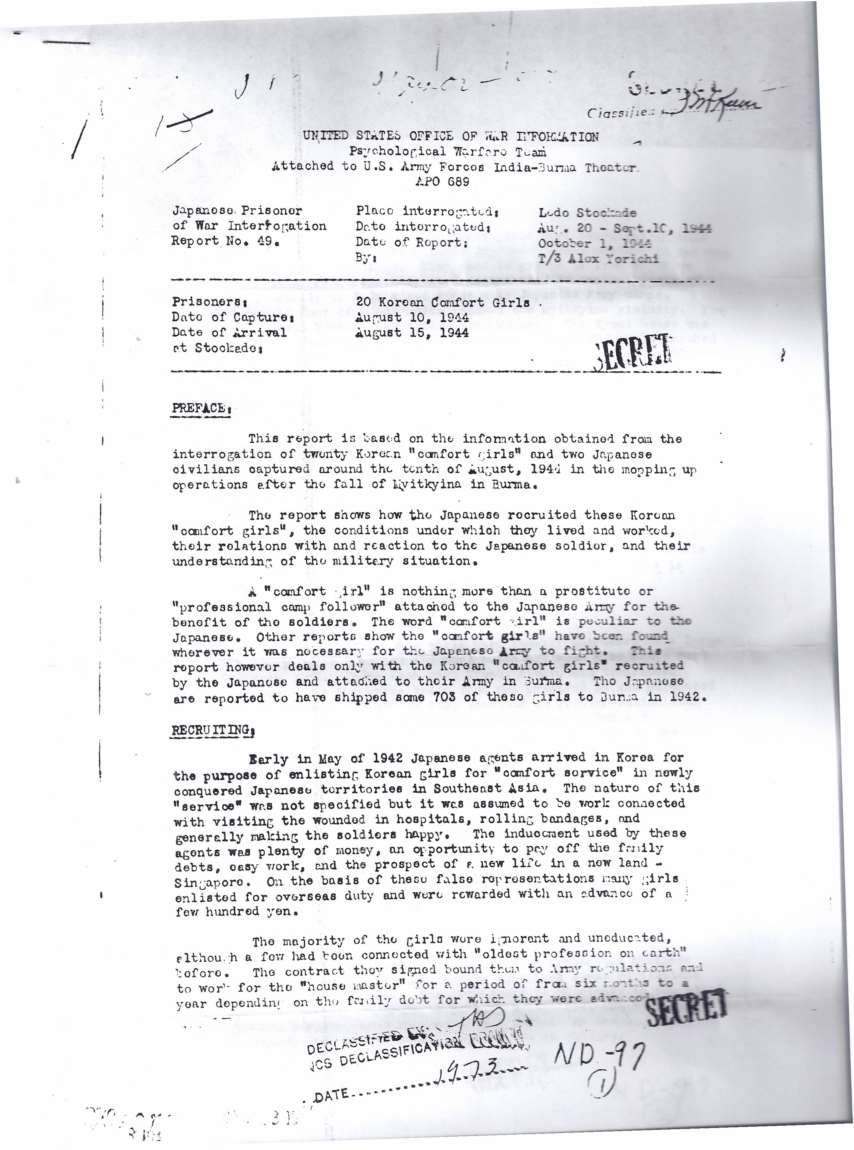
OFFICE OF WAR INFORMATION
Psychological Warfare Team
Attached to
U.S. Army Forces
India-Burma Theater
APO 689
Japanese Prisoner
of War Interrogation
Report No. 49.
Place interrogated: Ledo Stockade
Date Interrogated: Aug. 20 - Sept. 10, 1944
Date of Report: October 1, 1944
By: T/3 Alex Yorichi
Prisoners: 20 Korean Comfort Girls
Date of Capture: August 10, 1944
Date of Arrival: August 15, 1994
at Stockade
Thisreport is based on the information obtained from the interrogation oftwenty Korean "comfort girls" and two Japanese civilians captured aroundthe tenth of August, 1944 in the mopping up operations after the fallof Myitkyin a in Burma.
Thereport shows how the Japanese recruited these Korean "comfort girls",the conditions under which they lived and worked, their relations withand reaction to the Japanese soldier, and their understanding of themilitary situation.
A "comfort girl" is nothing more than a prostitute or "professionalcamp follower" attached to the Japanese Army for the benefit of the soldiers. The word"comfort girl" is peculiar to the Japanese. Other reports showthe "comfort girls" have been found wherever it was necessaryfor the Japanese Army to fight. This report however deals only with theKorean "comfort girls" recruited by the Japanese and attachedto their Army in Burma. The Japanese are reported to have shipped some703 of these girls to Burma in 1942.
RECRUITING;
Earlyin May of 1942 Japanese agents arrived in Korea for the purpose ofenlisting Korean girls for "comfort service" in newly conquered Japaneseterritories in Southeast Asia. The nature of this "service" was notspecified but it was assumed to be work connected with visiting thewounded in hospitals, rolling bandages, and generally making thesoldiers happy. The inducement used by these agents was plenty of money,an opportunity to pay off the family debts, easy work, and the prospectof a new life in a new land, Singapore. On the basis of these falserepresentations many girls enlisted for overseas duty and were rewardedwith an advance of a few hundred yen.
Themajority of the girls were ignorant and uneducated, although a few hadbeen connected with "oldest profession on earth" before. The contractthey signed bound them to Army regulations and to war for the "housemaster " for a period of from six months to a year depending on thefamily debt for which they were advanced ...
Click HERE to download this page アメリカ戦時情報局心理作戦班
アメリカ陸軍インド・ビルマ戦域軍所属
APO689戦時
日本人
捕虜尋問報告
第49号
尋問場所:レド捕虜収容所
尋問期間:1944年8月20日〜9月10日
報告年月日 1944年10月1日
報告者 T/3
アレックス・ヨリチ
捕虜 朝鮮人慰安婦20名
捕獲日:1944年8月10日
収容所到着日:1944年8月15日はじめに
この報告は、1944年8月10日ごろ、ビルマのミッチナ陥落後の掃討作戦において捕らえられた20名の朝鮮人「慰安婦」と2名の日本の民間人に対する尋問から得た情報に基づくものである。
この報告は、これら朝鮮人「慰安婦」を募集するために日本軍が用いた方法、慰安婦の生活および労働の条件、日本軍兵士に対する慰安婦の関係と反応、軍事情勢についての慰安婦の理解程度を示している。
「慰安婦」とは、将兵のために日本軍に所属している売春婦、つまり「追軍売春婦(日本軍を追いかけて来た売春婦)」にほかならない。「慰安婦」という用語は、日本軍特有のものである。この報告以外にも、日本軍にとって戦闘の必要のある場所ではどこにでも「慰安婦」が存在してきたことを示す報告がある。しかし、この報告は、日本人によって雇用され、かつ、ビルマ駐留日本軍に所属している朝鮮;人「慰安婦」だけについて述べるものである。日本は、1942年にこれらの女性およそ703名を海上輸送したと伝えられている。
募 集;
1942年5月初旬、日本の斡旋業者たちが、日本軍によって新たに征服された東南アジア諸地域における「慰安役務」に就く朝鮮;人女性を募集するため、朝鮮に到着した。この「役務」の性格は明示されなかったが、それは病院にいる負傷兵を見舞い、包帯を巻いてやり、そして一般的に言えば、将兵を喜ばせることにかかわる仕事であると考えられていた。これらの周旋業者が用いる誘いのことばは、多額の金銭と、家族の負債を返済する好機、それに、楽な仕事と新天地シンガポールにおける新生活という将来性であった。このような偽りの説明 を信じて、多くの女性が海外勤務に応募し、2〜3百円の前渡金を受け取った。
これらの女性のうちには、「地上で最も古い職業」に以前からかかわっていた者も若干いたが、大部分は売春について無知、無教育であった。彼女たちが結んだ契約は、家族の借金返済に充てるために前渡された金額に応じて6ヵ月から1年にわたり、彼女たちを軍の規則と「慰安所の楼主」のための役務に束縛した。

Approximately800 of these girls were recruited in this manner and they landed withtheir Japanese "house master " at Rangoon around August 20th, 1942. Theycame in groups of from eight to twenty-two. From here they weredistributed to various parts of Burma, usually to fair sized towns nearJapanese Army camps.
Eventually four of these units reached the Myitkyina. They were,Kyoei, Kinsui, Bakushinro, and Momoya. The Kyoei house was called the"Maruyama Club", but was changed when the girls reached Myitkyina asCol.Maruyama, commander of the garrison at Myitkyina, objected to thesimilarity to his name.
PERSONALITY;
Theinterrogations show the average Korean "comfort girl" to be abouttwenty-five years old, uneducated, childish, and selfish. She is notpretty either by Japanese of Caucasian standards. She is inclined to beegotistical and likes to talk about herself. Her attitude in front ofstrangers is quiet and demure, but she "knows the wiles of a woman." Sheclaims to dislike her "profession" and would rather not talk eitherabout it or her family. Because of the kind treatment she received as aprisoner from American soldiers at Myitkyina and Ledo, she feels thatthey are more emotional than Japanese soldiers. She is afraid of Chineseand Indian troops.
LIVING AND WORKING CONDITIONS;
In Myitkyina the girls were usually quartered in a large two story house(usually a school building) with a separate room for each girl. There eachgirl lived, slept, and transacted business. In Myitkina their food wasprepared by and purchased from the "house master" as they receivedno regular ration from the Japanese Army. They lived in near-luxury in Burma in comparison to other places. This was especially true of their second year in Burma. They lived well because their food and material was not heavily rationedand they had plenty of money with which to purchase desired articles. Theywere able to buy cloth, shoes, cigarettes, and cosmetics to supplementthe many gifts given to them by soldiers who had received "comfortbags" from home.
Whilein Burma they amused themselves by participating in sports events withboth officers and men, and attended picnics, entertainments, and socialdinners. They had a phonograph and in the towns they were allowed to goshopping.
PRIOR SYSTEM;
Theconditions under which they transacted business were regulated by theArmy, and in congested areas regulations were strictly enforced. TheArmy found it necessary in congested areas to install a system ofprices, priorities, and schedules for the various units operating in aparticular areas. According to interrogations the average system was asfollows:
Click HERE to download this pageこれらの女性およそ800人が、このようにして徴集され、1942年8月20日ごろ、「慰安所の楼主(雇い主)」に連れられてラングーンに上陸した。彼女たちは、8人ないし22人の集団でやって来た。彼女たちは、ここからビルマの諸地方に、通常は日本軍駐屯地の近くにあるかなりの規模の都会に配属された。結局、これらの集団のうちの四つがミッチナ付近に到達した。それらの集団は、キョウエイ、キンスイ、バクシンロウ、モモヤであった。キョウエイ慰安所は「マルヤマクラブ」と呼ばれていたが、ミッチナ駐屯部隊長の丸山大佐が、彼の名前に似た名称であることに異議を唱えたため、慰安婦たちが到着したさいに改称された。
性 質;
尋問により判明したところでは、平均的な朝鮮;人慰安婦は25歳くらいで、無教育、幼稚、気まぐれ、そして、わがままである。慰安婦は、日本的基準からいっても白人的基準からいっても、美人ではない。とかく自己中心的で、自分のことばかり話したがる。見知らぬ人の前では、もの静かでとりすました態度を見せるが、「女の手練手管を心得ている」。自分の「職業」が嫌いだといっており、仕事のことについても家族のことについても話したがらない。捕虜としてミッチナやレドのアメリカ兵から親切な扱いを受けたために、アメリカ兵のほうが日本兵よりも人情深いと感じている。慰安婦は中国兵とインド兵を怖がっている。
生活および労働の環境;
ミッチナでは慰安婦たちは、通常、個室のある二階建ての大規模家屋(普通は学校の校舎)に宿泊していた。それぞれの慰安婦は、そこで寝起きし、業を営ん だ。彼女たちは、日本軍から一定の食料を買っていた。ビルマでの彼女たちの暮らしぶりは、贅沢ともいえるほどであった。この点はビルマ生活2年目について特に言えることであった。食料・物資の配給量は多くなかったが、欲しい物品を購入するお金はたっぷり貰っていたので、彼女たちの暮らし向きは良かった。彼女たちは、故郷から慰問袋をもらった兵士がくれるいろいろな贈り物に加えて、それを補う衣類、靴、紙巻きタバコ、化粧品を買うことができた。
彼女たちは、ビルマ滞在中、将兵と一緒にスポーツ行事に参加して楽しく過ごし、また、ピクニック、演奏会、夕食会に出席した。彼女たちは蓄音機をもっていたし、都会では買い物に出かけることが許された。
優先順位料金等;
慰安婦の営業条件は軍によって規制され、慰安所の利用どの高い地域では、規則は厳格に実施された。利用度の高い地域では、軍は料金、利用優先順位、および特定地域で作戦を実施している各部隊のための利用時間割り当て制を設ける必要があると考えた。尋問によれば普通の料金は次のとおりであった。

1. Soldiers
10 AM to 5 PM
1.50 yen
20 to 30 minutes
2. NCOs
5 PM to 9 PM
3.00 yen
30 to 40 minutes
3. Officers
9 PM to 12 PM
5.00 yen
30 to 40 minutes
Thesewere average prices in Central Burma. Officers were allowed to stayovernight for twenty yen. In Myitkyina Col. Maruyama slashed the pricesto almost one-half of the average price.
SCHEDULES;
Thesoldiers often complained about congestion in the houses. In manysituations they were not served and had to leave as the army was verystrict about overstaying. In order to overcome this problem the Army setaside certain days for certain units. Usually two men from the unit forthe day were stationed at the house to identify soldiers. A roving MPwas also on hand to keep order. Following is the schedule used by the"Kyoei" house for the various units of the 18th pision while atNaymyo.
Sunday
18th p. Hdqs. Staff
Monday
Cavalry
Tuesday
Engineers
Wednesday
Day off and weekly physical exam.
Thursday
Medics
Friday
Mountain artillery
Saturday
Transport
Officers were allowed to come seven nights a week. The girls complained that even with the schedule congestion was so greatthat they could not care for all guests, thus causing ill feeling amongmany of the soldiers.
Soldiers would come to the house, pay the price and get tickets of cardboardabout two inches square with the prior on the left side and the name ofthe house on the other side. Each soldier"s identity or rank was then establishedafter which he "took his turn in line". The girls were allowed the prerogative of refusing a customer. This was often done if the person were too drunk.
PAY AND LIVING CONDITIONS;
The"house master" received fifty to sixty per cent of the girls" grossearnings depending on how much of a debt each girl had incurred when shesigned her contract. This meant that in an average month a girl wouldgross about fifteen hundred yen. She turned over seven hundred and fiftyto the "master". Many "masters" made life very difficult for the girlsby charging them high prices for food and other articles.
Inthe latter part of 1943 the Army issued orders that certain girls whohad paid their debt could return home. Some of the girls were thusallowed to return to Korea.
Theinterrogations further show that the health of these girls was good.They were well supplied with all types of contraceptives, and oftensoldiers would bring their own which
Click HERE to download this page 1.兵午前10時〜午後5時 1.5 円20〜30分 2.下士官午後5時〜午後9時 3 円30〜40分 3.将校午後9時〜午後12時 5 円30〜40分以上は中部ビルマにおける平均的料金であった。将校は20円で泊まることも認められていた。ミッチナでは、丸山大佐は料金を値切って相場の半分近くまで引き下げた。
利用日割り当て表;
兵士たちは、慰安所が混んでいるとしばしば不満を訴えた。規定時間外利用(営業時間外)については、軍がきわめて厳しい態度をとっていたので、多くの場合、彼らは女性と会えずに引き揚げなければならなかった。この問題を解決するため、軍は各部隊のために特定日を設けた。その日の要員として、通常当該部隊員2名が、隊員の確認のために慰安所に配置された。秩序を保つため、監視任務の憲兵も見まわった。第18師団がメイミョーに駐留したさい、各部隊のために「キョウエイ」慰安所が使用した利用日割表は、次のとおりである。日曜日――第18師団司令部。
月曜日――騎兵隊
火曜日――工兵隊
水曜日――休業日、定例健康診断
木曜日――衛生隊
金曜日――山砲兵隊
土曜日――輜重隊将校は週に夜7回利用することが認められていた。慰安婦たちは、日割表どおりでも利用度がきわめて高いので、すべての客を相手にすることはできず、その結果、多くの兵士の間に険悪な感情を生みだすことになるとの不満をもらしていた。
兵士たちは慰安所にやって来て、料金を支払い、厚紙でこしらえた約2インチ四方の利用券を買ったが、それには左側に料金額、右側に慰安所の名称が書かれていた。次に、それぞれの兵士の所属と階級が確認され、そののちに兵士は「列をつくって順番を待った」。慰安婦は接客を断る権利を認められていた。接客拒否は、客が泥酔している場合にしばしば起こることであった。
報酬および生活状態
「慰安所の楼主」は、それぞれの慰安婦が、契約を結んだ時点でどの程度の債務額を負っていたかによって差はあるものの、慰安婦の稼ぎの総額の50ないし60パーセントを受け取っていた。これは、慰安婦が普通の月で総額1500円程度の稼ぎを得ていたことを意味する。慰安婦は、「楼主」に750円を渡していたのである。多くの「楼主」は、食料、その他の物品の代金として慰安婦たちに多額の請求をしていたため、彼女たちは生活困難に陥った。
1943年の後期に、軍は、借金を返済し終わった特定の慰安婦には帰国を認める旨の指示を出した。その結果、一部の慰安婦は朝鮮に帰ることを許された。
さらにまた、尋問が明らかにしているところによれば、これらの慰安婦の健康状態は良好であった。彼女たちは、あらゆるタイプの避妊具を十分に支給されており、

hadbeen supplied by the army. They were well trained in looking after boththemselves and customers in the matter of hygiene. A regular JapaneseArmy doctor visited the houses once a week and any girl found diseasedwas given treatment, secluded, and eventually sent to a hospital. Thissame procedure was carried on within the ranks of the Army itself, butit is interesting to note that a soldier did not lose pay during theperiod he was confined.
REACTIONS TO JAPANESE SOLDIERS;
Intheir relations with the Japanese officers and men only two names ofany consequence came out of interrogations. They were those of Col.Maruyama, commander of the garrison at Myitkyina and Maj. Gen.Mizukami,who brought in reinforcements. The two were exact opposites. The formerwas hard, selfish and repulsive with no consideration for his men; thelatter a good, kind man and a fine soldier, with the utmostconsideration for those who worked under him. The Colonel was a constanthabitué of the houses while the General was never known to have visitedthem. With the fall of Myitkyina, Col. Maruyama supposedly desertedwhile Gen. Mizukami committed suicide because he could not evacuate themen.
SOLDIERS REACTIONS;
Theaverage Japanese soldier is embarrassed about being seen in a "comforthouse" according to one of the girls who said, "when the place is packedhe is apt to be ashamed if he has to wait in line for his turn". However there were numerous instances of proposals of marriage and in certaincases marriages actually took place.
Allthe girls agreed that the worst officers and men who came to see themwere those who were drunk and leaving for the front the following day.But all likewise agreed that even though very drunk the Japanese soldiernever discussed military matters or secrets with them. Though the girlsmight start the conversation about some military matter the officer orenlisted man would not talk, but would in fact "scold us for discussingsuch un-lady like subjects. Even Col. Maruyama when drunk would neverdiscuss such matters."
Thesoldiers would often express how much they enjoyed receiving magazines,letters and newspapers from home. They also mentioned the receipt of"comfort bags" filled with canned goods, magazines, soap, handkerchiefs,toothbrush, miniature doll, lipstick, and wooden clothes. The lipstickand cloths were feminine and the girls couldn"t understand why thepeople at home were sending such articles. They speculated that thesender could only have had themselves or the "native girls".
Click HERE to download this pageまた、兵士たちも、軍から支給された避妊具を自分のほうからもって来る場合が多かった。慰安婦は衛生に関して、彼女たち自身についても客についても気配りすように十分な訓練を受けていた。日本軍の正規の軍医が慰安所を週に一度訪れたが、罹患していると認められた慰安婦はすべて処置を施され、隔離されたのち、最終的には病院に送られた。軍そのものの中でも、まったく同じ処置が施されたが、興味深いこととしては、兵士は入院してもその期間の給与をもらえなくなることはなかったという点が注目される。
日本の軍人に対する反応;
慰安婦と日本軍将兵との関係において、およそ重要 な人物としては、二人の名前が尋問から浮かび上がっただけである。それは、ミッチナ駐屯部隊指揮官の丸山大佐と、増援部隊を率いて来た水上少将であった。両者の性格は正反対であった。前者は、冷酷かつ利己的な嫌悪すべき人物で、部下に対してまったく思いやりがなかったが、後者は、人格のすぐれた心のやさしい人物であり、またりっぱな軍人で、彼のもとで仕事をする人たちに対してこの上ない思いやりをもっていた。大佐は慰安所の常連であったのに対し、後者が慰安所にやって来たという話は聞かなかった。ミッチナの陥落と同時に丸山大佐は脱出してしまったものと思われるが、水上将軍のほうは、部下を撤退させることができなかったという理由から自決した。
兵士たちの反応;
慰安婦の一人によれば、平均的な日本軍人は、「慰安所」にいるところを見られるのをきまり悪がり、彼女が言うには、「慰安所が大入り満員で、並んで順番を待たなければならない場合には、たいてい恥ずかしがる」そうである。しかし、結婚申し込みの事例はたくさんあり、実際に結婚が成立した例もいくつかあった。
すべての慰安婦の一致した意見では、彼女たちのところへやって来る将校と兵士のなかで最も始末が悪いのは、酒に酔っていて、しかも、翌日戦前に向かうことになっている連中であった。しかし、同様に彼女たちが口を揃えて言うには、日本の軍人は、たとえどんなに酔っていても、彼女たちを相手にして軍事にかかわる事柄や秘密について話すことは決してなかった。慰安婦たちが何か軍事上の事柄についての話を始めても、将校も下士官や兵士もしゃべろうとしないどころか、「そのような、女にふさわしくないことを話題にするな、といつも叱ったし、そのような事柄については丸山大佐でさえ、酒に酔っているときでも決して話さなかった」。
しばしば兵士たちは、故郷からの雑誌、手紙、新聞を受け取るのがどれほど楽しみであるかを語った。彼らは、缶詰、雑誌、石鹸、ハンカチーフ、歯ブラシ、小さな人形、口紅、下駄などがいっぱい入った「慰問袋」を受け取ったという話もした。口紅や下駄は、どう考えても女性向きのものであり、慰安婦たちには、故郷の人びとがなぜそのような品物を送ってくるのか理解できなかった。彼女たちは、送り主にしてみれば、自分自身つまり「本来の女性」を心に描くことしかできなかったのであろうと推測した。

REACTION TO THE MILITARY SITUATION;
It appears they knew very little about the military situation around Myitkyinaeven up to and including the time of
their retreat and capture. There is however some information worth nothing:
"In the initial attack on Myitleyna and the airstrip about two hundredJapanese died in battle, leaving about two hundred to defend the town.Ammunition was very low.
"Col.Maruyama dispersed his men. During the following days the enemy wereshooting haphazardly everywhere. It was a waste since they didn"t seemto aim at any particular thing. The Japanese soldiers on the other handhad orders to fire one shot at a time and only when they were sure of ahit."
Beforethe enemy attacked on the west airstrip, soldiers stationed aroundMyitkyina were dispatched elsewhere, to storm the Allied attack in theNorth and West. About four hundred men were left behind, largely fromthe 114th Regiment. Evidently Col. Maruyama did not expect the town tobe attacked. Later Maj. Gen. Mizukami of the 56th pision brought inreinforcements of more than two regiments but these were unable to holdthe town.
Itwas the consensus among the girls that Allied bombings were intense andfrightening and because of them they spent most of their last days infoxholes. One or two even carried on work there. The comfort houses werebombed and several of the girls were wounded and killed.
Click HERE to download this page軍事情勢に対する反応;
慰安婦たちは、彼女たちが退却し捕虜になる時点まで、さらにはその時点においても、ミッチナ周辺の軍事情勢については、ほとんど何も知らなかったようである。しかし、注目に値する若干の情報がある。
「ミッチナおよび同地の滑走路に対する最初の攻撃で、約200名の日本兵が戦死し、同市の防衛要員は200名程度になった。弾薬量はきわめて少なかった。」
「丸山大佐は部下を散開させた。その後数日間、敵は、いたる所で当てずっぽうに射撃していた。これという特定の対象を標的にしているようには思われなかったから、むだ撃ちであった。これに反して、日本兵は、一度に一発、それも間違いなく命中すると判断したときにのみ撃つように命令されていた。」
ミッチナ周辺に配備されていた兵士たちは、敵が西滑走路に攻撃をかける前に別の場所に急派され、北部および西部における連合国軍の攻撃を食い止めようとした。主として第114連隊所属の約400名が取り残された。明らかに、丸山大佐は、ミッチナが攻撃されるとは思っていなかったのである。その後、第56歩兵団の水上少将がニ箇連隊〔小隊〕以上の増援部隊を率いて来たものの、それをもってしても、ミッチナを防衛することはできなかった。
慰安婦たちの一致した言によれば、連合国軍による爆撃は度肝を抜くほど熾烈であり、そのため、彼女たちは最後の時期の大部分を蛸壺〔避難壕〕のなかで過ごしたそうである。そのような状況のなかで仕事を続けた慰安婦も1、2名いた。慰安所が爆撃され、慰安婦数名が負傷して死亡した。
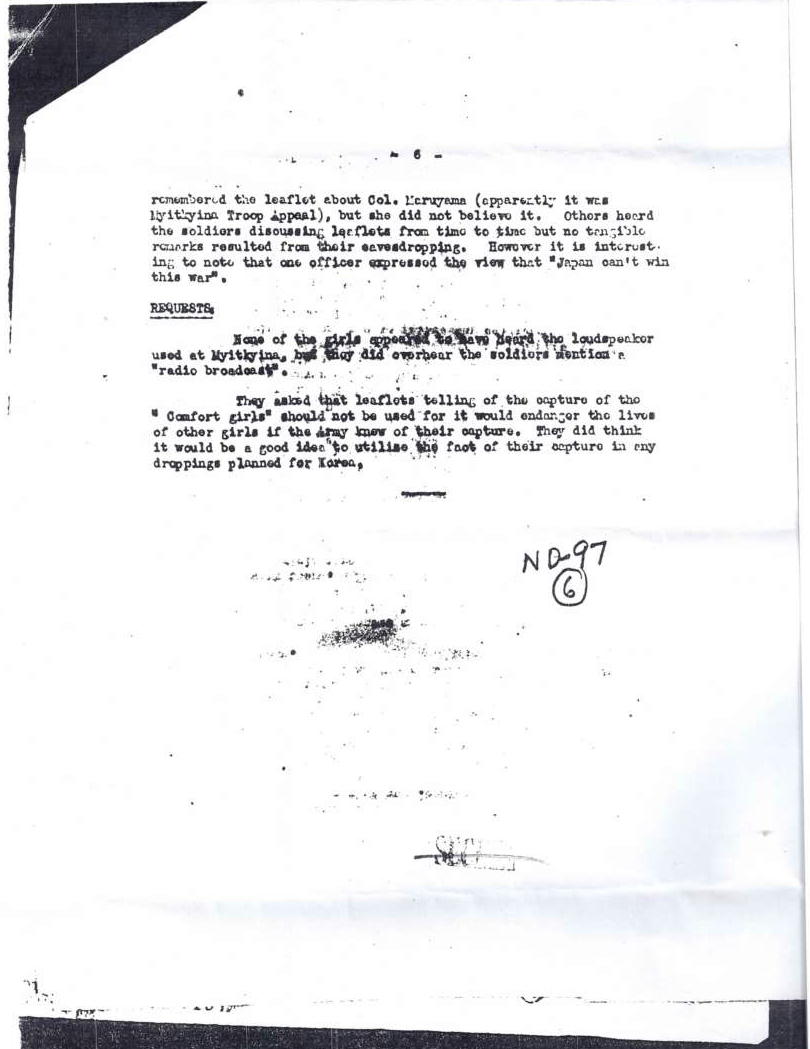
REQUESTS
Noneof the girls appeared to have heard the loudspeaker used at Myitkyinabut very did overhear the soldiers mention a "radio broadcast."
Theyasked that leaflets telling of the capture of the "comfort girls"should not be used for it would endanger the lives of other girls if theArmy knew of their capture. They did think it would be a good idea toutilize the fact of their capture in any droppings planned for Korea.
Click HERE to download this page宣 伝;
慰安婦たちは、使用されていた反日宣伝リーフレットのことは、ほとんど何も知らなかった。慰安婦たちは兵士が手にしていたリーフレットを2、3見たことはあったが、それは日本語で書かれていたし、兵士は彼女たちを相手にそれについて決して話そうとはしなかったので、内容を理解できた慰安婦はほとんどいなかった。一人の慰安婦が丸山大佐についてのリーフレット(それはどうやらミッチナ駐屯部隊へのアピールだったようであるが)のことうを覚えていたが、しかし、彼女はそれを信じなかった。兵士がリーフレットのことを話しあっているのを聞いた慰安婦も何人かいたが、彼女たちたまたま耳にしたからといって、具体的な話を聞くことはなかった。しかし、興味深い点としては、ある将校が「日本はこの戦争に勝てない」との見解を述べたことが注目される。
要 望;
慰安婦のなかで、ミッチナで使用された拡声器による放送を聞いた者は誰もいなかったようだが、彼女たちは、兵士が「ラジオ放送」のことを話しているのを確かに聞いた。
彼女たちは、「慰安婦」が捕虜になったことを報じるリーフレットは使用しないでくれ、と要望した。彼女たちが捕虜になったことを軍が知ったら、たぶん他の慰安婦の生命が危険になるからである。しかし、慰安婦たちは、自分たちが捕虜になったという事実を報じるリーフレットを朝鮮で計画されていると盂家に活用するのは名案であろうと、確かに考えたのである。

Click HERE to download this page
付録A
以下はこの報告に用いられた情報を得るために尋問を受けた20人の朝鮮;人「慰安婦」と日本人民間人2人の名前である。朝鮮;人名は音読みで表記してい る。
名 年齢 住 所
1 「S」 21歳 慶尚南道晋州
2 「K」 28歳 慶尚南道三千浦〔以下略〕
3 「P」 26歳 慶尚南道晋州
4 「C」 21歳 慶尚北道大邱
5 「C」 27歳 慶尚南道晋州
6 「K」 25歳 慶尚北道大邱
7 「K」 19歳 慶尚北道大邱
8 「K」 25歳 慶尚南道釜山
9 「K」 21歳 慶尚南道クンボク
(ママ)
10 「K」 22歳 慶尚南道大邱
11 「K」 26歳 慶尚南道晋州
12 「P」 27歳 慶尚南道晋州
(ママ)
13 「C」 21歳 慶尚南道慶山郡〔以下略〕
14 「K」 21歳 慶尚南道咸陽〔以下略〕
15 「Y」 31歳 平安南道平壌
16 「O」 20歳 平安南道平壌
17 「K」 20歳 京畿道京城
18 「H」 21歳 京畿道京城
19 「O」 20歳 慶尚北道大邱
20 「K」 21歳 全羅南道光州
日本人民間人
1 キタムラトミコ 38歳 京畿道京城
2 キタムラエイブン 41歳 京畿道京城
