
Envelope sent by National Archives to confirm the validity of the followingdocuments.
Recipient Mr. Tony Marano (PropagandaBuser : Texas Daddy : 텍사스 아버지)
Click each photo for larger image
Click HERE to download full archives in zip file.미국 국립 공문서관에서(보다) 텍사스 아버지에게 보내져 온 봉투와 편지
왼쪽의 사진을 클릭으로 확대
모든 파일 일괄 다운로드하려면 여기를 클릭
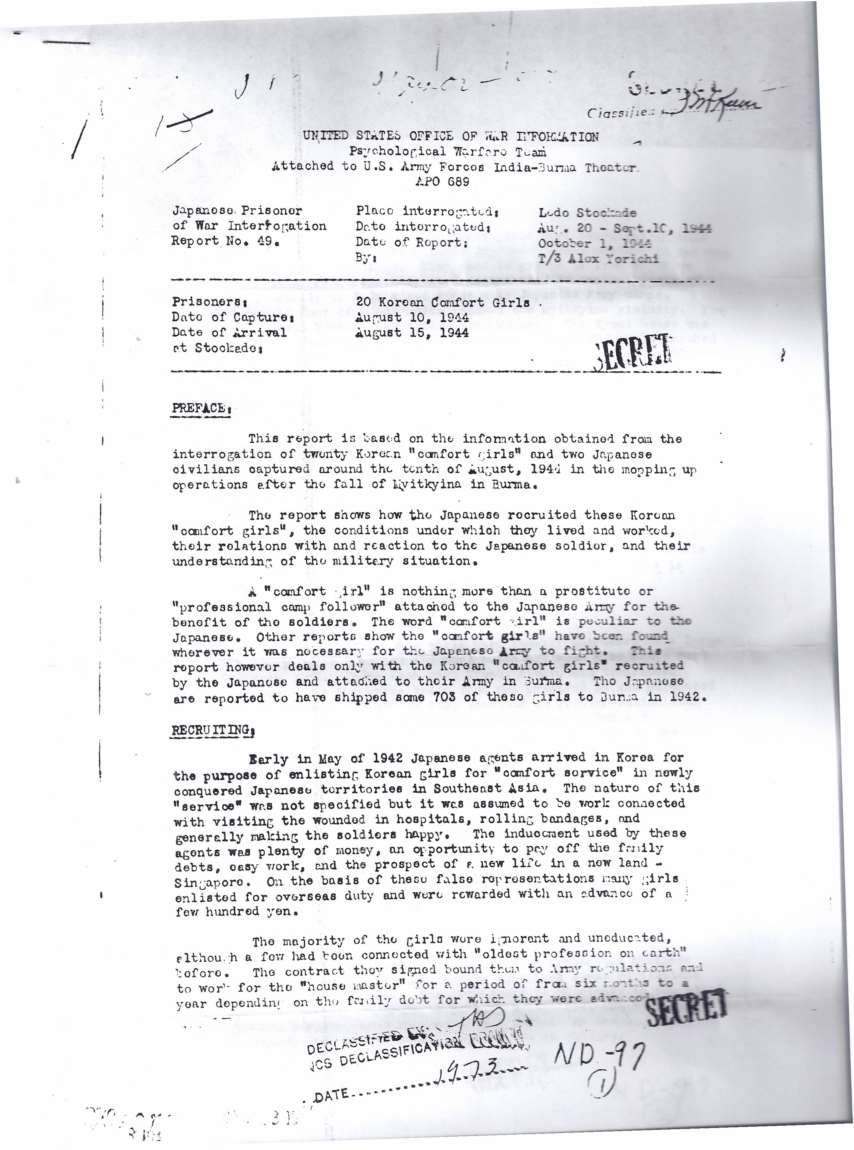
OFFICE OF WAR INFORMATION
Psychological Warfare Team
Attached to
U.S. Army Forces
India-Burma Theater
APO 689
Japanese Prisoner
of War Interrogation
Report No. 49.
Place interrogated: Ledo Stockade
Date Interrogated: Aug. 20 - Sept. 10, 1944
Date of Report: October 1, 1944
By: T/3 Alex Yorichi
Prisoners: 20 Korean Comfort Girls
Date of Capture: August 10, 1944
Date of Arrival: August 15, 1994
at Stockade
Thisreport is based on the information obtained from the interrogation oftwenty Korean "comfort girls" and two Japanese civilians captured aroundthe tenth of August, 1944 in the mopping up operations after the fallof Myitkyin a in Burma.
Thereport shows how the Japanese recruited these Korean "comfort girls",the conditions under which they lived and worked, their relations withand reaction to the Japanese soldier, and their understanding of themilitary situation.
A "comfort girl" is nothing more than a prostitute or "professionalcamp follower" attached to the Japanese Army for the benefit of the soldiers. The word"comfort girl" is peculiar to the Japanese. Other reports showthe "comfort girls" have been found wherever it was necessaryfor the Japanese Army to fight. This report however deals only with theKorean "comfort girls" recruited by the Japanese and attachedto their Army in Burma. The Japanese are reported to have shipped some703 of these girls to Burma in 1942.
RECRUITING;
Earlyin May of 1942 Japanese agents arrived in Korea for the purpose ofenlisting Korean girls for "comfort service" in newly conquered Japaneseterritories in Southeast Asia. The nature of this "service" was notspecified but it was assumed to be work connected with visiting thewounded in hospitals, rolling bandages, and generally making thesoldiers happy. The inducement used by these agents was plenty of money,an opportunity to pay off the family debts, easy work, and the prospectof a new life in a new land, Singapore. On the basis of these falserepresentations many girls enlisted for overseas duty and were rewardedwith an advance of a few hundred yen.
Themajority of the girls were ignorant and uneducated, although a few hadbeen connected with "oldest profession on earth" before. The contractthey signed bound them to Army regulations and to war for the "housemaster " for a period of from six months to a year depending on thefamily debt for which they were advanced ...
Click HERE to download this page 미국 전시 정보국심리 작전반
미국 육군 인도・버마 전역군소속
APO689전시
일본인
포로 심문 보고
제49호
심문 장소:레드 포로 수용소
심문 기간:1944년 8월 20일〜9월 10일
보고 연월일 1944년 10월 1일
보고자 T/3
알렉스・요리치
포로 조선인 위안부 20명
포획일:1944연 8월 10일
수용소 도착일:1944연 8월 15일처음에
이 보고는, 1944년 8월 10일경, 버마의 밋치나 함락 후의 소탕 작전에 대해 잡힌 20명의 조선인「위안부」와 2명의 일본의 민간인에 대한 심문으로부터 얻은 정보에 근거하는 것이다.
이 보고는, 이것들 조선인「위안부」를 모집하기 위해서 일본군이 이용한 방법, 위안부의 생활 및 노동의 조건, 일본 군병사에 대한 위안부의 관계와 반응, 군사 정세에 대한 위안부의 이해 정도를 나타내고 있다.
「위안부」와는, 장병을 위해서 일본군에 소속해 있는 매춘부, 즉「추군매춘부(일본군을 뒤쫓아 온 매춘부)」와 다름없다.「위안부」라고 하는 용어는, 일본군특유의 것이다.이 보고 이외에도, 일본군에 있어서 전투의 필요가 있는 장소에서는 어디에라도「위안부」가 존재해 온 것을 나타내 보이는 보고가 있다.그러나, 이 보고는, 일본인에 의해서 고용되어 한편, 버마 주둔 일본군에 소속해 있는 조선;인「위안부」인 만큼 대해 말하는 것이다.일본은, 1942년에 이러한 여성 대략 703명을 해상운송 했다고 전하고 있다.
모집;
1942년 5 월초순, 일본?`후 알선 업자들이, 일본군에 의해서 새롭게 정복된 동남아시아제지역에 있어서의「위안 역무」에 오르는 조선;인 여성을 모집하기 위해(때문에), 조선에 도착했다.이「역무」의 성격은 명시되지 않았지만, 그것은 병원에 있는 부상병을 문병해, 붕대를 감아 주어, 그리고 일반적으로 말하면, 장병을 기쁘게 하는 것에 관계되는 일이다고 생각되고 있었다.이러한 중개업자가 이용하는 권유의 말은, 고액의 금전과 가족의 부채를 반제하는 호기, 거기에, 편한 일과 신천지 싱가폴에 있어서의 신생활이라고 하는 장래성이었다.이러한 거짓의 설명을 믿고, 많은 여성이 해외 근무에 응모해, 2〜3백엔의 전도금을 받았다.
이러한 여성의 집에는, 「지상에서 가장 낡은 직업」에 이전때문인지 변하고 있던 사람도 약간 있었지만, 대부분은 매춘에 대해 무지, 무교육이었다.그녀들이 묶은 계약은, 가족의 빚반제에 충당하기 전 건네받은 금액에 따라 6개월부터 1년에 걸쳐, 그녀들을 군의 규칙과「위안소의 가루의 주인」를 위한 역무에 속박 했다.

Approximately800 of these girls were recruited in this manner and they landed withtheir Japanese "house master " at Rangoon around August 20th, 1942. Theycame in groups of from eight to twenty-two. From here they weredistributed to various parts of Burma, usually to fair sized towns nearJapanese Army camps.
Eventually four of these units reached the Myitkyina. They were,Kyoei, Kinsui, Bakushinro, and Momoya. The Kyoei house was called the"Maruyama Club", but was changed when the girls reached Myitkyina asCol.Maruyama, commander of the garrison at Myitkyina, objected to thesimilarity to his name.
PERSONALITY;
Theinterrogations show the average Korean "comfort girl" to be abouttwenty-five years old, uneducated, childish, and selfish. She is notpretty either by Japanese of Caucasian standards. She is inclined to beegotistical and likes to talk about herself. Her attitude in front ofstrangers is quiet and demure, but she "knows the wiles of a woman." Sheclaims to dislike her "profession" and would rather not talk eitherabout it or her family. Because of the kind treatment she received as aprisoner from American soldiers at Myitkyina and Ledo, she feels thatthey are more emotional than Japanese soldiers. She is afraid of Chineseand Indian troops.
LIVING AND WORKING CONDITIONS;
In Myitkyina the girls were usually quartered in a large two story house(usually a school building) with a separate room for each girl. There eachgirl lived, slept, and transacted business. In Myitkina their food wasprepared by and purchased from the "house master" as they receivedno regular ration from the Japanese Army. They lived in near-luxury in Burma in comparison to other places. This was especially true of their second year in Burma. They lived well because their food and material was not heavily rationedand they had plenty of money with which to purchase desired articles. Theywere able to buy cloth, shoes, cigarettes, and cosmetics to supplementthe many gifts given to them by soldiers who had received "comfortbags" from home.
Whilein Burma they amused themselves by participating in sports events withboth officers and men, and attended picnics, entertainments, and socialdinners. They had a phonograph and in the towns they were allowed to goshopping.
PRIOR SYSTEM;
Theconditions under which they transacted business were regulated by theArmy, and in congested areas regulations were strictly enforced. TheArmy found it necessary in congested areas to install a system ofprices, priorities, and schedules for the various units operating in aparticular areas. According to interrogations the average system was asfollows:
Click HERE to download this page이러한 여성 대략 800명이, 이와 같이 해 징집 되어 1942년 8월 20일경, 「위안소의 가루의 주인(고용주)」에 이끌려 랭군에 상륙했다.그녀들은, 8명내지 22명의 집단에서 왔다.그녀들은, 여기에서 버마의 제지방에, 통상은 일본군주둔지의 근처에 걸어든지의 규모의 도시에 배속되었다.결국, 이러한 집단 중 네 개가 밋치나 부근에 도달했다.그러한 집단은, 쿄웨이, 킨스이, 바크신로우, 모모야였다.쿄웨이 위안소는「마르야마크라브」로 불리고 있었지만, 밋치나 주둔 부대장의 마루야마 대령이, 그의 이름을 닮은 명칭인 것에 이의를 주장했기 때문에, 위안부들이 도착한 때로 개칭되었다.
성질;
심문에 의해 판명된 곳은, 평균적인 조선;인 위안부는 25세 정도로, 무교육, 유치, 변덕, 그리고, 멋대로이다.위안부는, 일본식 기준으로부터 말해도 백인적 기준으로부터 말해도, 미인은 아니다.대체로 자기중심적으로, 자신(뿐)만 이야기 하고 싶어한다.낯선 사람의 앞에서는, 조용하고 점잔뺀 태도를 보이지만, 「여자의 농간을 알고 있는 」.자신의「직업」가 싫다고 하고 있어 일에 대해서도 가족에 대해서도 이야기했지만들 없다.포로로서 밋치나나 레드의 미국병사로부터 친절한 취급을 받았기 때문에, 미국병사 쪽이 일본병보다 인정많다고 느끼고 있다.위안부는 중국병과 인도병을 무서워하고 있다.
생활 및 노동의 환경;
밋치나에서는 위안부들은, 통상, 개인실이 있는 이층건물의 대규모 가옥(보통은 학교의 교사)에 숙박하고 있었다.각각의 위안부는, 거기서 자고 일어나기 해, 업을 영위했다.그녀들은, 일본군으로부터 일정한 식료를 사고 있었다.버마에서의 그녀들의 생활 모습은, 호화라고도 할 수 있는 만큼에서 만났다.이 점은 버마 생활 2년 눈에 띄어 특별히 말할 수 있는 것이었다.식료・물자의 배급량은 많지 않았지만, 갖고 싶은 물품을 구입하는 돈은 충분히 받고 있었으므로, 그녀들의 살림살이는 좋았다.그녀들은, 고향으로부터 위문대를 받은 병사가 주는 여러가지 선물에 가세하고, 그것을 보충하는 의류, 구두, 종이로 접음 담배, 화장품을 살 수 있었다.
그녀들은, 버마 체제중, 장병과 함께 스포츠 행사에 참가해 즐겁게 보내, 또, 피크닉, 연주회, 저녁 식사회에 출석했다.그녀들은 축음기를 갖고 있었고, 도시에서는 쇼핑하러 나가는 것이 허락되었다.
우선 순위 요금등;
위안부의 영업 조건은 군에 의해서 규제되어 위안소의 이용 어느 높은 지역에서는, 규칙은 엄격하게 실시되었다.이용도의 높은 지역에서는, 군은 요금, 이용 우선 순위, 및 특정 지역에서 작전을 실시하고 있는 각부대를 위한 이용 시간표 맞혀 제를 제정할 필요가 있다고 생각했다.심문에 의하면 보통 요금은 다음과 같았다.

1. Soldiers
10 AM to 5 PM
1.50 yen
20 to 30 minutes
2. NCOs
5 PM to 9 PM
3.00 yen
30 to 40 minutes
3. Officers
9 PM to 12 PM
5.00 yen
30 to 40 minutes
Thesewere average prices in Central Burma. Officers were allowed to stayovernight for twenty yen. In Myitkyina Col. Maruyama slashed the pricesto almost one-half of the average price.
SCHEDULES;
Thesoldiers often complained about congestion in the houses. In manysituations they were not served and had to leave as the army was verystrict about overstaying. In order to overcome this problem the Army setaside certain days for certain units. Usually two men from the unit forthe day were stationed at the house to identify soldiers. A roving MPwas also on hand to keep order. Following is the schedule used by the"Kyoei" house for the various units of the 18th pision while atNaymyo.
Sunday
18th p. Hdqs. Staff
Monday
Cavalry
Tuesday
Engineers
Wednesday
Day off and weekly physical exam.
Thursday
Medics
Friday
Mountain artillery
Saturday
Transport
Officers were allowed to come seven nights a week. The girls complained that even with the schedule congestion was so greatthat they could not care for all guests, thus causing ill feeling amongmany of the soldiers.
Soldiers would come to the house, pay the price and get tickets of cardboardabout two inches square with the prior on the left side and the name ofthe house on the other side. Each soldier"s identity or rank was then establishedafter which he "took his turn in line". The girls were allowed the prerogative of refusing a customer. This was often done if the person were too drunk.
PAY AND LIVING CONDITIONS;
The"house master" received fifty to sixty per cent of the girls" grossearnings depending on how much of a debt each girl had incurred when shesigned her contract. This meant that in an average month a girl wouldgross about fifteen hundred yen. She turned over seven hundred and fiftyto the "master". Many "masters" made life very difficult for the girlsby charging them high prices for food and other articles.
Inthe latter part of 1943 the Army issued orders that certain girls whohad paid their debt could return home. Some of the girls were thusallowed to return to Korea.
Theinterrogations further show that the health of these girls was good.They were well supplied with all types of contraceptives, and oftensoldiers would bring their own which
Click HERE to download this page 1.군사오전 10시〜오후 5시 1.5 엔20〜30분 2.하사관오후 5시〜오후 9시 3 엔30〜40분 3.장교오후 9시〜오후 12시 5 엔30〜40분이상은 중부 버마에 있어서의 평균적 요금이었다.장교는 20엔으로 묵는 일도 인정되고 있었다.밋치나에서는, 마루야마 대령은 요금을 깎아 시세의 반 근처까지 인하했다.
이용 일당 맞혀 겉(표);
병사들은, 위안소가 혼잡하면 자주 불만을 호소했다.규정 시간외 이용(영업 시간외)에 대해서는, 군이 극히 어려운 태도를 취하고 있었으므로,많은 경우, 그들은 여성과 만나지 못하고 돌아오지 않으면 안 되었다.이 문제를 해결하기 위해(때문에), 군은 각부대를 위해서 특정일을 마련했다.그 날의 요원으로서 통상 해당 부대원 2명이, 대원의 확인을 위해서 위안소에 배치되었다.질서를 유지하기 위해, 감시 임무의 헌병도 둘러 보았다.제18 사단이 메이 묘하게 주둔했고 말이야 있어, 각부대를 위해서「쿄웨이」위안소가 사용한 이용 일당표는, 다음과 같다.일요일―― 제18 사단 사령부.
월요일――기병대
화요일――공병대
수요일――휴업일, 정례 건강진단
목요일――위생대
금요일――산지 전투를 위한 대포 군인
토요일――치중대장교는 주에 밤 7회 이용하는 것이 인정되고 있었다.위안부들은, 일당표 대로에서도 이용도가 극히 높기 때문에, 모든 손님을 상대로 하지 못하고, 그 결과, 많은 병사의 사이에 험악한 감정을 만들어 내게 된다라는 불만을 누설하고 있었다.
병사들은 위안소에 오고, 요금을 지불해, 판지로 만든 약 2 인치 사방의 이용권을 샀지만, 거기에는 좌측으로 요금액, 우측으로 위안소의 명칭이 쓰여져 있었다.다음에, 각각의 병사의 소속과 계급이 확인되어 그 후에 병사는「열을 만들고 차례를 기다린 」.위안부는 접객을 거절할 권리를 인정받고 있었다.접객 거부는, 손님이 만취하고 있는 경우에 자주 일어나는 것이었다.
보수 및 생활상태
「위안소의 가루의 주인」는, 각각의 위안부가, 계약을 맺은 시점에서 어느 정도의 채무액수를 부담하고 있었는지를 따르고 차이는 있지만, 위안부의 돈벌이의 총액의 50내지 60퍼센트를 받고 있었다.이것은, 위안부가 보통 달에 총액 1500엔 정도의 돈벌이를 얻고 있던 것을 의미한다.위안부는, 「가루의 주인」에 750엔을 건네주고 있었던 것이다.많은「가루의 주인」는, 식료, 그 외의 물품의 대금으로 해서 위안부들에게 고액의 청구를 하고 있었기 때문에, 그녀들은 생활 곤란에 빠졌다.
1943년의 후기에,군은, 빚을 다 반제한 특정의 위안부에게는 귀국을 인정하는 취지의 지시를 내렸다.그 결과, 일부의 위안부는 조선에 돌아가는 것이 용서되었다.
한층 더 또,심문이 분명히 하는데 따르면, 이러한 위안부의 건강 상태는 양호했다.그녀들은, 모든 타입의 피임 도구를 충분히 지급되고 있어

hadbeen supplied by the army. They were well trained in looking after boththemselves and customers in the matter of hygiene. A regular JapaneseArmy doctor visited the houses once a week and any girl found diseasedwas given treatment, secluded, and eventually sent to a hospital. Thissame procedure was carried on within the ranks of the Army itself, butit is interesting to note that a soldier did not lose pay during theperiod he was confined.
REACTIONS TO JAPANESE SOLDIERS;
Intheir relations with the Japanese officers and men only two names ofany consequence came out of interrogations. They were those of Col.Maruyama, commander of the garrison at Myitkyina and Maj. Gen.Mizukami,who brought in reinforcements. The two were exact opposites. The formerwas hard, selfish and repulsive with no consideration for his men; thelatter a good, kind man and a fine soldier, with the utmostconsideration for those who worked under him. The Colonel was a constanthabitué of the houses while the General was never known to have visitedthem. With the fall of Myitkyina, Col. Maruyama supposedly desertedwhile Gen. Mizukami committed suicide because he could not evacuate themen.
SOLDIERS REACTIONS;
Theaverage Japanese soldier is embarrassed about being seen in a "comforthouse" according to one of the girls who said, "when the place is packedhe is apt to be ashamed if he has to wait in line for his turn". However there were numerous instances of proposals of marriage and in certaincases marriages actually took place.
Allthe girls agreed that the worst officers and men who came to see themwere those who were drunk and leaving for the front the following day.But all likewise agreed that even though very drunk the Japanese soldiernever discussed military matters or secrets with them. Though the girlsmight start the conversation about some military matter the officer orenlisted man would not talk, but would in fact "scold us for discussingsuch un-lady like subjects. Even Col. Maruyama when drunk would neverdiscuss such matters."
Thesoldiers would often express how much they enjoyed receiving magazines,letters and newspapers from home. They also mentioned the receipt of"comfort bags" filled with canned goods, magazines, soap, handkerchiefs,toothbrush, miniature doll, lipstick, and wooden clothes. The lipstickand cloths were feminine and the girls couldn"t understand why thepeople at home were sending such articles. They speculated that thesender could only have had themselves or the "native girls".
Click HERE to download this page또, 병사들도, 군으로부터 지급된 피임 도구를 자신 쪽으로부터도는 오는 경우가 많았다.위안부는 위생에 관해서, 그녀들 자신에 대해서도 손님에 대해서도 배려같게 충분한 훈련을 받고 있었다.일본군의 정규의 군의관이 위안소를 주에 한 번 방문했지만, 이환하고 있다고 인정된 위안부는 모두 처치를 실시해져 격리된 후, 최종적으로는 병원에 보내졌다.군그 자체 중(안)에서도, 완전히 같은 처치가 실시해졌지만, 흥미로운 일로서는, 병사는 입원해도 그 기간의 급여를 받을 수 없게 될 것은 없었다고 하는 점이 주목받는다.
일본의 군인에 대한 반응;
위안부와 일본군장병과의 관계에 대하고, 대략 중요 인물로서는, 두 명의 이름이 심문으로부터 떠오른 것만으로 있다.그것은, 밋치나 주둔 부대 지휘관 마루야마 대령과 증원 부대를 인솔해 온 수상 소장이었다.양자의 성격은 정반대였다.전자는, 냉혹하고 이기적인 혐오 해야 할 인물로, 부하에 대해서 전혀 배려가 없었지만, 후자는, 인격의 뛰어난심의 상냥한 인물이며, 또 훌륭한 군인으로, 그의 아래에서 일을 하는 사람들에 대해서 이 이상 없는 배려를 갖고 있었다.대령은 위안소의 단골인 것에 대해, 후자가 위안소에 왔다고 하는 이야기는 듣지 않았다.밋치나의 함락과 동시에 마루야마 대령은 탈출해 버린 것이라고 생각되지만, 수상 장군 쪽은, 부하를 철퇴시킬 수 없었다고 하는 이유로부터 자결했다.
병사들의 반응;
위안부의 한 명에 의하면, 평균적인 일본 군인은, 「위안소」에 있을 곳을 볼 수 있는 것을 규칙악꾸중, 그녀가 말하려면 , 「위안소가 가득찬 만원으로, 줄서 차례를 기다리지 않으면 안 되는 경우에는, 대부분 부끄러워하는」그렇다.그러나,결혼 신청의 사례는 많이 있어, 실제로 결혼이 성립한 예도 몇개인가 있었다.
모든 위안부의 일치해?`스 의견에서는, 그녀들의 곳으로 오는 장교와 병사 속에서 가장 시말이 나쁜 것은, 술에 취하고 있고, 게다가, 다음날 전쟁 전이 다가오게 되어 있는 무리였다.그러나, 똑같이 그녀들이 입을 모아 말하려면 , 일본의 군인은, 비록 아무리 취하고 있어도, 그녀들을 상대로 해 군사와 관계되는 일이나 비밀에 대해 이야기하는 것은 결코 없었다.위안부들이 무엇인가 군사상의 일에 대한 이야기를 시작해도, 장교도 하사관이나 병사도 말하려고 하지 않기는 커녕, 「그러한, 여자에 어울리지 않는 것을 화제로 하지 말아라, 물어 개도 꾸짖었고, 그러한 일에 대해서는 마루야마 대령조차, 술에 취하고 있을 때에도 결코 이야기하지 않았던 」.
자주 병사들은, 고향으로부터의 잡지, 편지, 신문을 받는 것이 얼마나 기다려진가를 말했다.그들은, 통조림, 잡지, 비누, 손수건, 칫솔, 작은 인형, 립스틱, 나막신등이 가득 들어간「위문대」를 받았다고 하는 이야기도 했다.립스틱이나 나막신은, 어떻게 생각해도 여성용의 것이며, 위안부들에게는, 고향의 사람들이 왜 그러한 물건을 배웅하고 오는지 이해할 수 없었다.그녀들은, 발송인으로 해 보면, 자기 자신 즉「모`{이래의 여성」를 마음에 그릴 수 밖에 할 수 없었기 때문에 있을것이다라고 추측했다.

REACTION TO THE MILITARY SITUATION;
It appears they knew very little about the military situation around Myitkyinaeven up to and including the time of
their retreat and capture. There is however some information worth nothing:
"In the initial attack on Myitleyna and the airstrip about two hundredJapanese died in battle, leaving about two hundred to defend the town.Ammunition was very low.
"Col.Maruyama dispersed his men. During the following days the enemy wereshooting haphazardly everywhere. It was a waste since they didn"t seemto aim at any particular thing. The Japanese soldiers on the other handhad orders to fire one shot at a time and only when they were sure of ahit."
Beforethe enemy attacked on the west airstrip, soldiers stationed aroundMyitkyina were dispatched elsewhere, to storm the Allied attack in theNorth and West. About four hundred men were left behind, largely fromthe 114th Regiment. Evidently Col. Maruyama did not expect the town tobe attacked. Later Maj. Gen. Mizukami of the 56th pision brought inreinforcements of more than two regiments but these were unable to holdthe town.
Itwas the consensus among the girls that Allied bombings were intense andfrightening and because of them they spent most of their last days infoxholes. One or two even carried on work there. The comfort houses werebombed and several of the girls were wounded and killed.
Click HERE to download this page군사 정세에 대한 반응;
위안부들은, 그녀들이 퇴각해 포로가 되는 시점까지, 또 그 시점에 있어도, 밋치나 주변의 군사 정세에 대해서는, 거의 아무것도 몰랐던 것 같다.그러나, 주목할 만하는 약간의 정보가 있다.
「밋치나 및 동지의 활주로에 대한 최초의 공격으로, 약 200명의 일본병이 전사해, 동시의 방위 요원은 200명 정도가 되었다.탄약량은 극히 적었다.」
「마루야마 대령은 부하를 산개 시켰다.그 후 몇일간, 적은, 도달하는 곳에서 억측에 사격하고 있었다.이렇다 할 특정의 대상을 표적으로 하고 있도록(듯이)는 생각되지 않았으니까, 헛됨격였다.이것에 반하고, 일본병은, 한 번에 일발, 그것도 틀림없이 명중한다고 판단했을 때에 마셔 공격하도록(듯이) 명령되고 있었다.」
밋치나 주변에 배치되고 있던 병사들은, 적이 서활주로에 공격을 걸기 전에 다른 장소에 급파되어 북부 및 서부에 있어서의 연합국군의 공격을 막으려고 했다.주로 제114 연대 소속의 약 400명이 남겨졌다.분명하게, 마루야마 대령은, 밋치나가 공격받는다고는 생각하지 않았던 것이다.그 후, 제56 보병단의 수상융`장이 니개연대〔소대〕이상의 증원 부대를 인솔해 왔지만, 그것을 가지고 해도, 밋치나를 방위할 수 없었다.
위안부들의 일치한 말에 의하면, 연합국군에 의한 폭격은 깜짝 놀라게 할 만큼 치열하고, 그 때문에, 그녀들은 마지막 시기의 대부분을 소호〔피난호〕 속에서 보냈다고 한다.그러한 상황 속에서 일을 계속한 위안부도 1, 2명 있었다.위안소가 폭격되어 위안부수명이 부상해 사망했다.
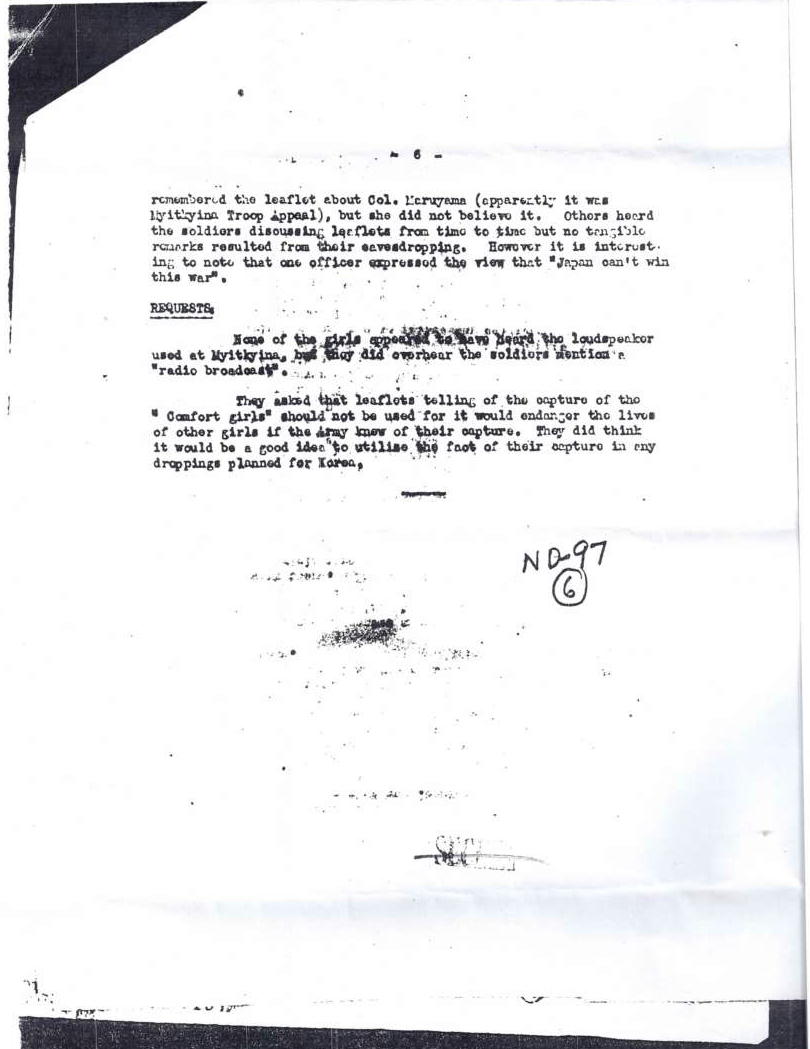
REQUESTS
Noneof the girls appeared to have heard the loudspeaker used at Myitkyinabut very did overhear the soldiers mention a "radio broadcast."
Theyasked that leaflets telling of the capture of the "comfort girls"should not be used for it would endanger the lives of other girls if theArmy knew of their capture. They did think it would be a good idea toutilize the fact of their capture in any droppings planned for Korea.
Click HERE to download this page선전;
위안부들은, 사용되고 있던 반일 선전 리플릿는, 거의 아무것도 몰랐다.위안부들은 병사가 손에 넣고 있던 리플릿을 2, 3본 것은 있었지만, 그것은 일본어로 쓰여져 해, 병사는 그녀들을 상대에게 거기에 붙어 결코 이야기하려고는 하지 않았기 때문에, 내용을 이해할 수 있던 위안부는 거의 없었다.한 명의 위안부가 마루야마 대령에 대한 리플릿(그것은 아무래도 밋치나 주둔 부대에의 어필이었던 것 같지만)의 고도를 기억하고 있었지만, 그러나, 그녀는 그것을 믿지 않았다.병사가 리플릿을 서로 이야기하고 있는 것을 (들)물은 위안부도 여러명 있었지만, 그녀들 우연히 들었다고, 구체적인 이야기를 들을 것은 없었다.그러나, 흥미로운 점으로서는, 어느A 장교가「일본은 이 전쟁에 이길 수 없는」라는 견해를 말했던 것이 주목받는다.
요망;
위안부 속에서, 밋치나로 사용된 확성기에 의한 방송을 (들)물은 사람은 아무도 없었던 것 같지만, 그녀들은, 병사가「라디오 방송」를 이야기하고 있는 것을 확실히 (들)물었다.
그녀들은, 「위안부」가 포로에게연을 알리는 리플릿은 사용하지 말고 주어와 요망했다.그녀들이 포로가 된 것을 군이 알면, 아마 다른 위안부의 생명이 위험하게 되기 때문이다.그러나, 위안부들은, 스스로가 포로가 되었다고 하는 사실을 알리는 리플릿을 조선에서 계획되고 있으면 우가에 활용하는 것은 명안이어도, 확실히 생각했던 것이다.

Click HERE to download this page
부록 A
이하는 이 보고에 이용된 정보를 얻기 위해서 심문을 받은 20명의 조선;인「위안부」와 일본인 민간인 2명의 이름이다.조선;인명은 음독으로 표기하고 있다.
명연령 주소
1 「S」 21세 경상남도 진주
2 「K」 28세 경상남도 삼천포〔이하약어 〕
3 「P」 26세 경상남도 진주
4 「C」 21세 경상북도 대구
5 「C」 27세 경상남도 진주
6 「K」 25세 경상북도 대구
7 「K」 19세 경상북도 대구
8 「K」 25세 경상남도 부산
9 「K」 21세 경상남도 쿠보크
(마마)
10 「K」 22세 경상남도 대구
11 「K」 26세 경상남도 진주
12 「P」 27세 경상남도 진주
(마마)
13 「C」 21세 경상남도 케이잔군〔이하약어 〕
14 「K」 21세 경상남도 함양〔이하약어 〕
15 「Y」 31세 평안 남도 평양
16 「O」 20세 평안 남도 평양
17 「K」 20세 경기도 경성
18 「H」 21세 경기도 경성
19 「O」 20세 경상북도 대구
20 「K」 21세 전라남도 광주
일본인 민간인
1 키탐라트미코 38세 경기도 경성
2 키탐라에이분 41세 경기도 경성