メインへ

KJCLUB 日韓文化交流へようこそ。

あほらしい Costa del sol

閲覧数 : 1,521
KO 255 organia 2,811,753


[[ Genetic Disparities Between Asian People ]]

Hideo Matsumoto, Department of Legal Medicine, Osaka Medical College, 569 Takatsuki, Osaka, Japan

Since the discovery in 1966 of the Gm ab3st gene, which characterizes Mongoloid populations, the distribution of allotypes of immunoglobulins (Gm) among Mongoloid populations scattered from Southeast Asia through East Asia to South America has been investigated, and the following conclusions can be drawn:

1. Mongoloid populations can be characterized by four Gm haplotypes, Gm ag, axg, ab3st, and afb1b3, and can be divided into two groups based on the analysis of genetic distances utilizing Gm haplotype frequency distributions: the first is a southern group characterized by a remarkably high frequency of Gm afb1b3 and a low frequency of Gm ag, and the second, a northern group characterized by a high frequency of both Gm ag and Gm ab3st but an extremely low frequency of Gm afb1b3.

2. Populations in China, mainly Han, show remarkable heterogeneity of Gm allotypes from north to south and contrast sharply to Korean and Japanese populations, which are considerably more homogenous with respect to these genetic markers. The center of dispersion of the Gm afb1b3 gene characterizing southern Mongoloids has been identified as the Guangxi and Yunnan area in the southwest of China.

3. The Gm ab3st gene, which is found with its the highest incidence among the northern Baikal Buriats, flows in all directions. However, this gene shows a precipitous drop from mainland China to Taiwan and Southeast Asia and from North to South America, although it is still found in high frequency among Eskimos, Koryaks, Yakuts, Tibetans, Olunchuns, Tungus, Koreans, Japanese, and Ainus. On the other hand, the gene was introduced into Huis, Uyghurs, Indians, Iranians, and spread as far as to include Hungarians and Sardinians in Italy. On the basis of these results, it is concluded that the Japanese race belongs to northern Mongoloids and that the origin of the Japanese race was in Siberia, and most likely in the Baikal area of the Soviet Un!on.

http://www.springerlink.com/index/M0N30Q13U0W03225.pdf

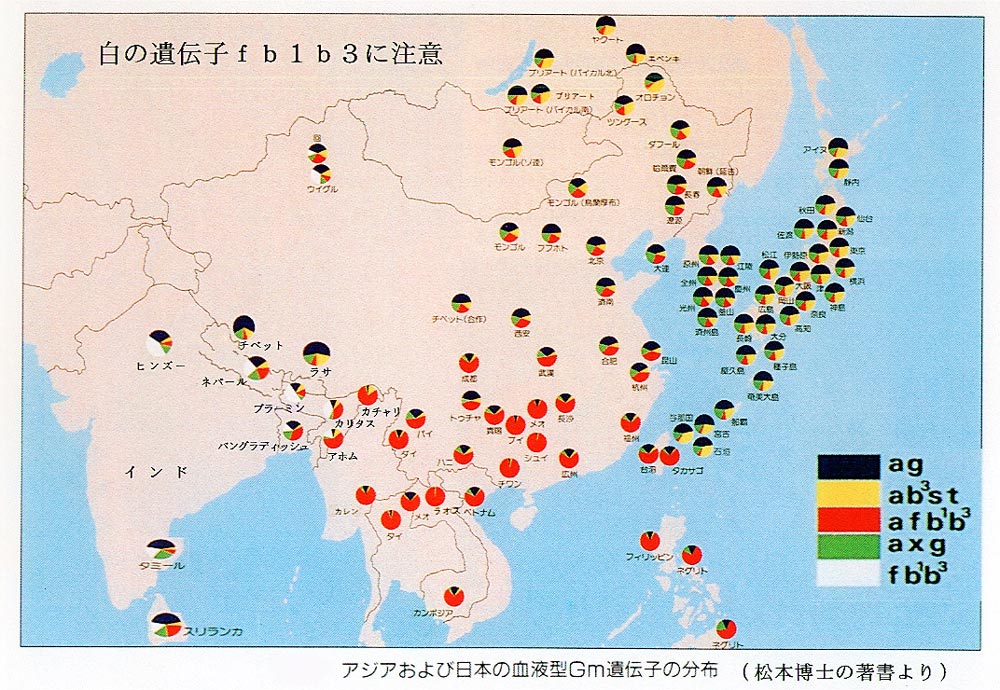
日本人遺伝学者の研究結果によれば, 北方係民族であればあるほど ab3st(黄色) 遺伝子は高く現われて, afb1b3(赤色) 遺伝子は低く現われている.

が日本人遺伝学者の結果で見たら... 北方係民族(高い ab3st遺伝子, 低い afb1b3遺伝子)は韓国人, 日本人, エスキモーである, チベットである, ツングースである, アイヌ人位で, 南方係民族(高い afb1b3遺伝子, 低い ab3st遺伝子)は中国人(台湾人含み)とその外東南アジア人だろう.

どこにも英語解釈もできない馬鹿 Costa del solがマルハンゴッのように ¥"韓国人はモンゴル人, 日本人は北方係である¥"という表現はない. 上の Hideo Matsumoto 教授の言葉によれば, アジア全体人を Mongoloidで表現したし, これを細分化して韓国人, エスキモー人のような北方アジア人を ¥"Northern Mongoloids¥"で, 中国/東南アジア人を ¥"Southern Mongoloids¥"で正義を下げている.

原文を見る

바보같은 Costa del sol


[[ Genetic Disparities Between Asian People ]]

Hideo Matsumoto, Department of Legal Medicine, Osaka Medical College, 569 Takatsuki, Osaka, Japan

Since the discovery in 1966 of the Gm ab3st gene, which characterizes Mongoloid populations, the distribution of allotypes of immunoglobulins (Gm) among Mongoloid populations scattered from Southeast Asia through East Asia to South America has been investigated, and the following conclusions can be drawn:

1. Mongoloid populations can be characterized by four Gm haplotypes, Gm ag, axg, ab3st, and afb1b3, and can be divided into two groups based on the analysis of genetic distances utilizing Gm haplotype frequency distributions: the first is a southern group characterized by a remarkably high frequency of Gm afb1b3 and a low frequency of Gm ag, and the second, a northern group characterized by a high frequency of both Gm ag and Gm ab3st but an extremely low frequency of Gm afb1b3.

2. Populations in China, mainly Han, show remarkable heterogeneity of Gm allotypes from north to south and contrast sharply to Korean and Japanese populations, which are considerably more homogenous with respect to these genetic markers. The center of dispersion of the Gm afb1b3 gene characterizing southern Mongoloids has been identified as the Guangxi and Yunnan area in the southwest of China.

3. The Gm ab3st gene, which is found with its the highest incidence among the northern Baikal Buriats, flows in all directions. However, this gene shows a precipitous drop from mainland China to Taiwan and Southeast Asia and from North to South America, although it is still found in high frequency among Eskimos, Koryaks, Yakuts, Tibetans, Olunchuns, Tungus, Koreans, Japanese, and Ainus. On the other hand, the gene was introduced into Huis, Uyghurs, Indians, Iranians, and spread as far as to include Hungarians and Sardinians in Italy. On the basis of these results, it is concluded that the Japanese race belongs to northern Mongoloids and that the origin of the Japanese race was in Siberia, and most likely in the Baikal area of the Soviet Un!on.

http://www.springerlink.com/index/M0N30Q13U0W03225.pdf

일본인 유전학자의 연구결과에 의하면, 북방계 민족일수록 ab3st(노란색) 유전자는 높게 나타나고, afb1b3(붉은색) 유전자는 낮게 나타나고 있다.

이 일본인 유전학자의 결과로 본다면... 북방계 민족(높은 ab3st유전자, 낮은 afb1b3유전자)은 한국인, 일본인, 에스키모인, 티벳인, 퉁구스인, 아이누인정도이고, 남방계 민족(높은 afb1b3유전자, 낮은 ab3st유전자)은 중국인(대만인포함)과 그외 동남아시아인이겠지.

어디에도 영어해석도 못하는 바보 Costa del sol이 말한것처럼 "한국인은 몽골인, 일본인은 북방계인"이라는 표현은 없다. 위 Hideo Matsumoto 교수의 말에 의하면, 아시아전체인을 Mongoloid로 표현했고, 이를 세분화 하여 한국인, 에스키모인과 같은 북방아시아인을 "Northern Mongoloids"로, 중국/동남아시아인을 "Southern Mongoloids"로 정의를 내리고 있음.

いいね・コメントにはログインが必要です。

コメント ( 0 )

投稿一覧

2,811,753

  1. JA 255 あかさたなはまやら
  2. JA 255 ef58
  3. KO 255 theStray
  4. JA 255 ヤンバン3
  5. KO 255 morort
  6. 閲覧数 : 50
    KO 255 bibimbap
  7. KO 255 theStray
  8. KO 255 avenger
  9. KO 255 propertyOfJapan
  10. 閲覧数 : 43
    KO 255 theStray
  11. KO 255 morort
  12. KO 255 theStray
  13. KO 255 propertyOfJapan
  14. KO 255 avenger
  15. JA 255 chosobakan
  16. KO 255 propertyOfJapan
  17. KO 255 theStray
  18. KO 255 theStray
  19. JA 255 あかさたなはまやら