
Hui Li · Ying Huang · Laura F. Mustavich · Fan Zhang, Jing-Ze Tan · Ling-E Wang · Ji Qian · Meng-He Gao ,Li Jin
Abstract
The ability to extract mitochondrial and nuclear DNA from ancient remains has enabled the study of ancient
DNA, a legitimate Weld for over 20 years now. Recently, Y chromosome genotyping has begun to be applied to ancient
DNA. The Y chromosome haplogroup in East Asia has since caught the attention of molecular anthropologists, as it is one
of the most ethnic-related genetic markers of the region. In this paper, the Y chromosome haplogroup of DNA from
ancient East Asians was examined, in order to genetically link them to modern populations. Fifty-six human remains
were sampled from five archaeological sites, primarily along the Yangtze River. Strict criteria were followed to eliminate
potential contamination. Five SNPs from the Y chromosome were successfully amplified from most of the samples, with
at least 62.5% of the samples belonging to the O haplogroup, similar to the frequency for modern East Asian populations.
A high frequency of O1 was found in Liangzhu Culture sites around the mouth of the Yangtze River, linking this culture
to modern Austronesian and Daic populations. A rare haplogroup, O3d, was found at the Daxi site in the middle reaches
of the Yangtze River, indicating that the Daxi people might be the ancestors of modern Hmong-Mien populations, which
show only small traces of O3d today. Noticeable genetic segregation was observed among the prehistoric cultures,
demonstrating the genetic foundation of the multiple origins of the Chinese Civilization.
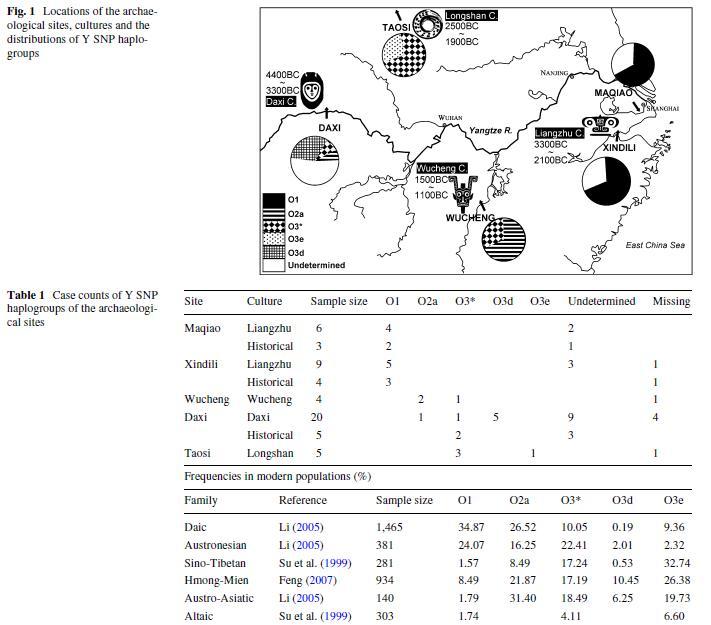
그리고 또 샘플과 자료.
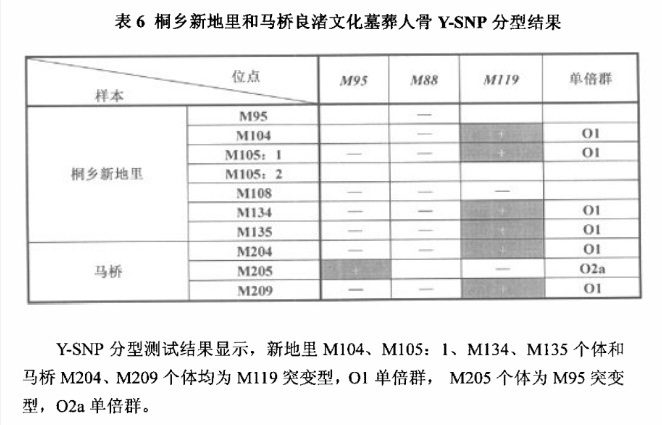
전부 O1과 O2a가 나온다.
연대에 관한 것은 논문 abstract를 보고 google.com에서 찾아보길 바란다.
2500-4000년 사이의 것들이다.
장강 하류는 거의 전부 O1a다.
소수의 O2a 또한 발견된다.