
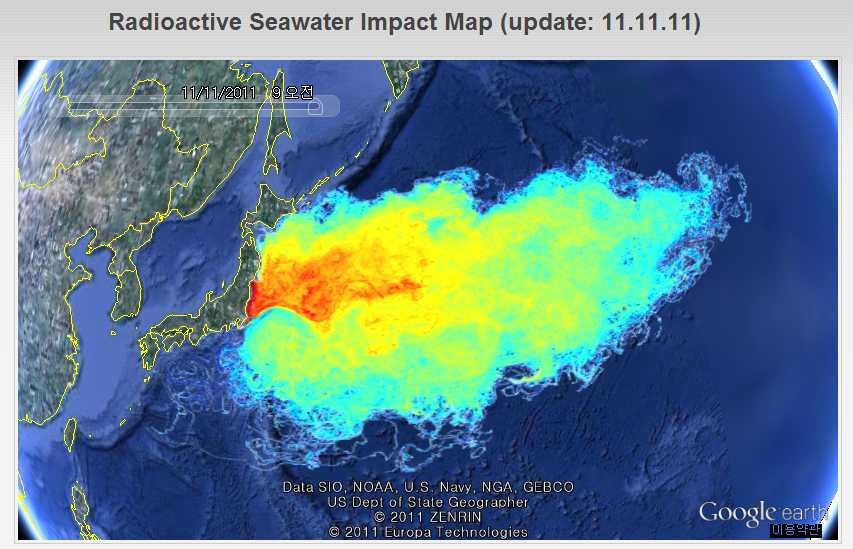
(후쿠시마방출) 방사성물질의 해수 영향 지도 (업데이트 : 2011년 11월 11일)
We use a Lagrangian particles dispersal method to track where free floating material (fish larvae, algae, phytoplankton, zooplankton...) present in the sea water near the damaged Fukushima Daiichi nuclear power station plant could have gone since the earthquake on March 11th. THIS IS NOT A REPRESENTATION OF THE RADIOACTIVE PLUME CONCENTRATION. Since we do not know how much contaminated water and at what concentration was released into the ocean, it is impossible to estimate the extent and dilution of the plume. However, field monitoring by TEPCO and modelling by the Sirrocco group in University of Toulouse, France both show high concentration in the surrounding water (highest rate at 80 Bq/L and 24 Bq/L for respectively I-131 and C-137) . Assuming that a part of the passive biomass could have been contaminated in the area, we are trying to track where the radionuclides are spreading as it will eventually climb up the food chain.
The dispersal model is ASR"s Pol3DD. The model is forced by hydrodynamic data from the HYCOM/NCODA system which provides on a weekly basis, daily oceanic current in the world ocean. The resolution in this part of the Pacific Ocean is around 8km x 8km cells. We are treating only the sea surface currents. Particles in the model are continuously released near the Fukushima Daiichi power plant since March 11th. The dispersal model keeps a trace of their visits in the model cells. The results here are expressed in number of visit per surface area of material which has been in contact at least once with the highly concentrated radioactive water.
우리는 손상된 후쿠시마 다이치 원전 근처 해수에 나타나는 부유물질 (물고기 알, 조류, 식물성 플랑크톤, 동물성 플랭크톤 등)들이 311 대지진 이래로 갈 수있는 곳을 추적하는 Lagrangian 입자 분산 방법을 사용합니다. 이것은 방사성물질 농도의 표현이 아닙니다. 얼마나 많은 오염된 물이 어떤 농도로 바다로 유입됐는지를 알 수 없기때문에 기동의 범위와 희석을 추정하는 것은 불가능합니다. 그러나 도쿄전력과 프랑스 툴루즈 대학교의 시로코 그룹에 의한 현장 모니터링은 둘다 모두 주변 해수(대표적으로 요오드131과 세슘137에서 80Bq/L과 24Bq/L에 최고 비율)에서 높은 농도를 보입니다. 이 지역에서 수동적으로 생물들 일부가 이 지역에서 오염됐을 수 있다는 전제하에, 우리는 방사성핵종이 점차 먹이 사슬을 따라 확산하는 것을 추적하려고 시도합니다. 분산모델은 ASR의 Pol3DD입니다. 이 모델은 전 세계바다에서 일간,주간단위로 제공된 HYCOM/NCODA 시스템의 유체데이터에 의해 영향받습니다. 태평양바다의 이 부분에서의 분할은 8kmX8km 셀입니다. 우리는 오직 바다표면 흐름을 취급니다.모델에서 입자들은 지속적으로 311 이래 후쿠시마 다이치 근처에서 방출됩니다. 분산 모델은 모델 셀에서 방문의 흔적을 유지합니다. 여기서 결과는 최소 한번 고농도 방사성 해수와 접촉한 물질의 표면면당 방문수를 나타냅니다.